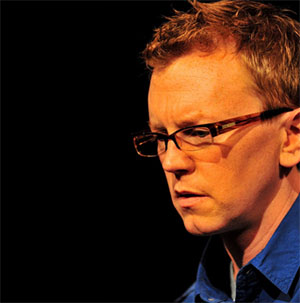
This is the story of how a boy who suffered from stuttering went on to be a radio announcer. And a radio engineer. And a salesman. And a TV weatherman. Kirk Harnack also has his own podcast on the TWIT network (www.live.twit.tv). Naturally, it’s about radio. For Kirk’s podcast click here.
Aaron Walter started drawing as a kid. He took art lessons, summer classes in cartooning and even set up a studio in the basement to encourage his love of painting. All that’s gone to waste.
Well, not really. Aaron isn’t a painter but he still draws every day. Even more importantly his uses his art background to solve problems. He says art helps you think creatively and laterally (finding connections between things). And creative problem solving is what helps him manage a team that make software interfaces more human. For Aaron Walter’s site click here.
If your film needed a tall, good looking boy who was a Boy Scout, did well in school, played football and was elected class president, you’d have described the childhood of Chuck DeVore. He learned hard work and self-reliance from his parents. And he learned how to overcome fear and pain from football.
Chuck earned a college degree in strategic studies, served as an Army officer, and was a staffer for a US congressman. And although he worked in aerospace for many years, Chuck is probably best known for the years he served in the California State Assembly. Politicians spend a lot of time on the road; they are like musicians without guitars. For Chuck DeVore’s site click here.
He was born in Deadwood, and raised in Spearfish but mostly Gary Mule Deer can be found on the road. He’s called a comedian-singer (and he is funny) but at heart Gary is a traveling musician.
In the early days, he roomed with comedian Steve Martin and singer Michael Johnson. And he’s often noted as a founding member of The Muledeer and Moondog Medicine Show. He was a hit but nearly lost it all to drugs and alcohol.
These days, clean and sober, Gary is still on the road. He’s either going to or coming back from a show he’s done with Johnny Mathis, playing a major casino or playing in a celebrity golf tournament. For Gary Mule Deer’s site click here.
Andrew Mayne is an illusionist, magician, writer and podcaster. He’s worked for some of the biggest names in magic, created magic tricks that will astound you, and put everything you need to know about magic in a book. Actually, several books. He’s also writing e-book fiction on Amazon.
His multifaceted career might be traced to growing up on two coasts but it’s not likely. It’s more likely that his quick wit isn’t easy to cage. His grandfather taught him his first magic trick but Andrew’s main insight was that adults can be fooled. Magic, then, is really just a game of critical thinking.
So Andrew’s best advice is to enjoy the illusions of a magic show but don’t be fooled about who you are. Understand your core values, be yourself, and, when in doubt, look at what makes you happy. And then do that. For Andrew Mayne website click here.
Amanda Gaddis is a writer. As a free lance writer for the web, she writes those posts that tell you how to plant flowers, live on the tundra and build a hovercraft in your spare time.
And her first novel is to be released this fall. Getting a book published is a long process. First you write it, send it out to publishers until someone gives a you contract, make revisions, do line edits (the comma on page 32 should be a period), print a mock up, print a few books, send them for reviews, market them on the web and through book distributers. And you’re published, and out of breath.
Why write a book that is sci-fi, fantasy and a bit wacky? Amanda ascribes it to having her father read Tolkien to her when she was a child. Sure she had some nightmares but look at how imaginative she became.
Although he grew up in a home environment that was more out-patient clinic than family fortress, Steve Blank found his passion for technology blossomed in the military. He also discovered the value of volunteering and honed the skill of troubleshooting. Now, as a writer and teacher, he shares the principles underlying entrepreneurism. And one lesson he has is that starting a business requires a different skill set than working in one. It’s an act of creation, and needs to be viewed in those terms. For Steve Blank’s website click here.